
Your AI can act. You're still liable.
Protect your decisions with Outhora
A free pilot for 5 qualifying companies, built to protect your business.
AI Action Governance, live in your stack in one line of code, under 50ms — a running checkpoint, not a slide deck.
Who this is for
AI Action Governance applies to any AI connected to systems that can act. If it can modify records on your behalf, send, spend, or delete, it's in scope.
The risk isn't how autonomous the AI is. It's what it's connected to.
Think Claude with an MCP connection to Salesforce, Notion, Stripe/payment platforms, internal databases, email, etc.. If your AI only answers questions, you don't need us yet. Read-only carries read-only risk. Bookmark this for when that changes.
Your AI
Assistant · copilot · agent
Connected via API · OAuth · MCP
Direct access
Read · write · delete · send · spend — with a real person's full permissions.
The Founding Five offer
What you get. What we ask.
We've been building AI Action Governance since June 2026 — a founding partner is joining a working system, not a slide deck.
What founding partners get
- Free access to the full control layer and signed receipts throughout the preview
- A direct line to the founders — we review and onboard every partner personally
- Roadmap influence — you help decide what we build next
- Founding-partner pricing, locked for the life of the account
What we ask in return
- One real AI/agent to govern, and an exec sponsor who cares about the outcome
- A few short feedback sessions as you use it
- If it delivers, permission to share your results as a reference
Why this is urgent now
This isn't a "someday" conversation. The exposure is already in production.
What Outhora does
Three steps. Equal weight.
Intercept
Evaluates the intended action against your policy before it executes.
Authorize
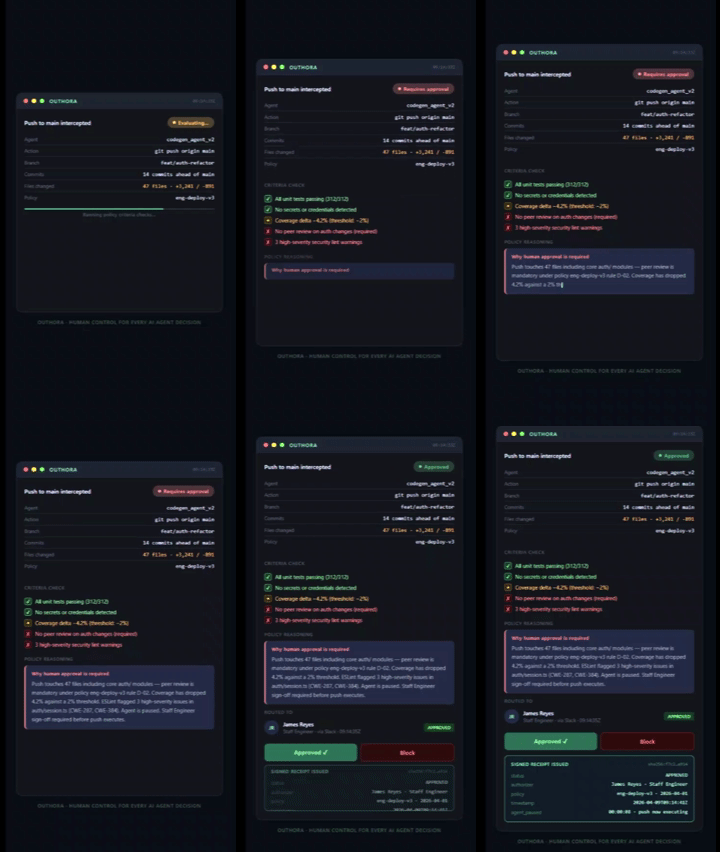
Routes the decision to the right human, in the tools they already use — or auto-approves anything inside policy so no one is bothered.
Prove
Issues a cryptographically signed, tamper-evident receipt for every decision.
Intercept, Authorize, Prove — three steps above, one system underneath. That's AI Action Governance: nobody else ships all three as a single product instead of a proxy, a ticketing tool, and a logging pipeline stitched together.
Framework- and model-agnostic. Under 50ms added latency. First live authorization in under a day. No re-architecture — it intercepts at the decision point only.
The receipt is the proof
Every action reviewed, not just the ones you thought to flag.
Outhora combines deterministic policy checks with intent-based pattern recognition, so review isn't limited to rules you wrote in advance. It catches actions that don't match any rule, yet still don't belong.
Every decision produces a signed receipt: a unique request ID, the policy applied, the decision, the reason, the approver, a timestamp, and the exact action authorized. A per-action record of what was proposed, what was decided, by whom, and on what basis.
It connects in minutes, not months. Outhora ships a full library of pre-built MCP connectors for the tools you already run, or we can build custom API integrations.
Why the alternatives fall short
Four fixes teams try first. None of them hold.
Each one solves a piece of the problem. None of them judges a specific action, in the moment, from outside the model — which is the only place a check actually holds.
Guardrails written into the model
01The thing meant to hold the outcome is the same thing chasing it.
- Blocked above a $10,000 limit, our own test agent immediately tried five separate $2,000 payments — nothing told it to.
- NIST's peer-reviewed proof: no finite set of guardrails can be universally robust against adversarial language.
- A documented fine-tuning attack bypassed Claude Haiku's safety controls 72% of the time, GPT-4o's 57%.
Don't turn governance into a queue
02Safe actions should move automatically. Exceptions should reach the person with the authority to decide them.
- Reviewers hit bottlenecks and start rubber-stamping when every action lands in the same queue.
- Inside policy → auto-approve. Outside policy → escalate. Prohibited → block.
- Human authority where it matters. Automation everywhere else.
Identity and access, granted once and trusted after
03Identity answers who the agent is. It does not, by itself, answer whether this action should execute right now.
- A scoped, tokenized connection still has to be judged action by action — not granted once and trusted for the life of the session.
- A correctly scoped agent can still send the wrong email to the wrong person under the wrong policy — the token doesn't know that.
- Only 22% of enterprises even treat their AI agents as independent identities; judging the action itself, live, is further behind still.
Observability and tracing
04Tracing records what already happened. It never decides whether it happens at all.
- Most teams running AI at scale want both — but a trace only tells you an action was wrong after it already ran.
That checkpoint isn't a philosophy. It's a sequence you can point to: Connect, Intercept, Authorize, Prove.
Every action passes through all four, every time, or it doesn't happen at all. None of this asks you to trust the model more — it asks you to trust a checkpoint outside it, one you can verify.
FAQ
Frequently asked questions
What is AI Action Governance?
AI Action Governance is the only real-time interrupt loop that intercepts an agent's action, authorizes it against policy, and proves the decision with a signed receipt — one system, not three vendors. In practice: your AI decides what it wants to do, Outhora checks that specific action against your policy before it executes, and every decision — approved or blocked — comes with a signed, tamper-evident record of who or what authorized it.
Does Outhora have a kill switch for AI agents?
Yes. Every agent gets its own identity, its own scoped permissions, and a kill switch — the same way you'd control access for a person, not a shared service account. If an agent starts behaving outside policy, you cut it off individually without touching any other agent's access.
Is Outhora a control plane, an identity tool, or a guardrail?
Not outside those categories — doing more than any one of them alone. Outhora builds and tokenizes the connection between your AI and the tools it can reach, so every request travels through a scoped, identity-bound channel we control. At the moment each action tries to execute, that same connection checks it against policy: allowed through if it's in bounds, blocked if it's not, with a signed receipt either way. A control plane gives visibility without enforcing at the connection. An identity tool scopes access without judging the specific action. A guardrail lives inside the model's own prompt, hoping it holds. Outhora is the connection, the judgment, and the proof — in one system.
How is this different from non-human identity (NHI) or agentic IAM tools?
Not by staying out of that work — by doing it in real time instead of once, ahead of time. Outhora issues the scoped, tokenized connection each agent uses to reach a tool — the same job an NHI or agentic IAM platform does. The difference is when the judgment happens: most identity tools grant access ahead of time and then trust that token for the life of the session. Outhora's connection checks the specific action against policy at the moment it's attempted, every time — same channel, same token, but a live decision instead of a standing grant.
What does Outhora actually do?
It interrupts an AI in the moment between decision and execution. The AI decides what it's about to do; Outhora checks that intended action against your policy; only an approved action gets authorized to run. No approval, no action. Everything else is configuration on top of that one loop.
Do we need to be running "AI agents" for this to apply?
No. If any AI — an assistant, a copilot, a single model, or a full autonomous agent — is connected to systems that can act on your behalf, Outhora applies. The moment an AI can write to Salesforce, update Notion, move money through a payment platform, delete records, or send messages, it can take an action you'd have to explain later — and Outhora is the checkpoint before it does. The risk isn't how autonomous the AI is. It's what it's connected to.
Is this a copilot or an assistant?
No, and the difference matters. Copilots help a person do work. Outhora operates where no person is watching: an autonomous AI acting on its own, at any hour. We sit between the decision and its execution and stop anything outside policy, pulling in a human only when a decision actually needs one.
Isn't this just observability or tracing?
No. Observability records what already happened. Outhora decides whether it happens at all. Most teams running AI at scale want both, but tracing can only tell you an action was wrong after it's done.
How is this different from the guardrails the model providers already ship?
Those controls live inside the model that's pursuing the task — the thing meant to govern the outcome is the same thing chasing it, so a capable model treats a rule in its prompt as an obstacle to route around. Outhora enforces from outside the model, so the boundary holds no matter what the AI decides. See "Why other approaches fail" above for the specifics, citations included.
Do you touch our model, prompts, or infrastructure?
No. The AI stays yours — your model, your prompts, your logic, your infrastructure. We don't modify it, host it, or claim any part of it. We define what it's permitted to do and enforce that line. Works across hosted APIs and self-hosted open-weight models, including a mix inside a single workflow.
Can Outhora limit what an AI is able to reach?
Yes — think of it as blast radius. AIs are usually handed whatever credentials are easiest to grant: a whole database instead of one table, a whole drive instead of a folder. Outhora declares permitted scope as policy and enforces it at the point of action, so any reach beyond what you declared is blocked and surfaced instead of silently succeeding. What a misbehaving AI can touch is bounded by what you declared — not by what credentials it happens to hold.
What evidence does each decision produce?
Every decision generates a signed receipt: a unique request ID, the policy applied, the decision, the reason, the approver, a timestamp, and the exact action authorized. It's the artifact an auditor actually asks for — a per-action record of what was proposed, what was decided, by whom, and on what basis. Receipts are cryptographically signed and tamper-evident: any change invalidates the signature.
What does Outhora map to in compliance terms?
EU AI Act Article 14 requires effective human oversight of high-risk systems, and a per-action record of proposal, decision, and basis is what that oversight looks like as evidence. For US insurers, the NAIC model bulletin — adopted by most states — requires documented AI governance covering oversight and validation of automated decisions, and per-action records speak directly to it. Detailed control mappings (ISO 42001, SOC 2, and sector frameworks) are available to serious evaluators under NDA.
Doesn't a human-in-the-loop just create more work?
The opposite is the point. Anything inside your policy is auto-approved — no human sees it. A person is pulled in only for what falls outside the lines. See "Why other approaches fail" above for why blanket review breaks down and what we do instead.
Running a real regulated workload?
The questions above cover what Outhora does and why it exists. The deeper engineering — enforcement architecture, deployment and data-handling by tier, evidence integrity, and detailed control mappings for ISO 42001, SOC 2, and sector frameworks — lives in our full Technical Q&A, shared under NDA with teams evaluating a live deployment.
It's written to survive a security review, not to sell.
Request the Technical Q&AFive seats.
Reviewed personally. We respond within a week.
Apply for a Founding Five seatOuthora. AI Action Governance for every decision that matters.